Fact Check: Was NATO Behind the Creation of Eurovision?
The Eurovision season has concluded for now, but people continue to discuss it, with some online assertions suggesting that the renowned song competition was established by NATO.
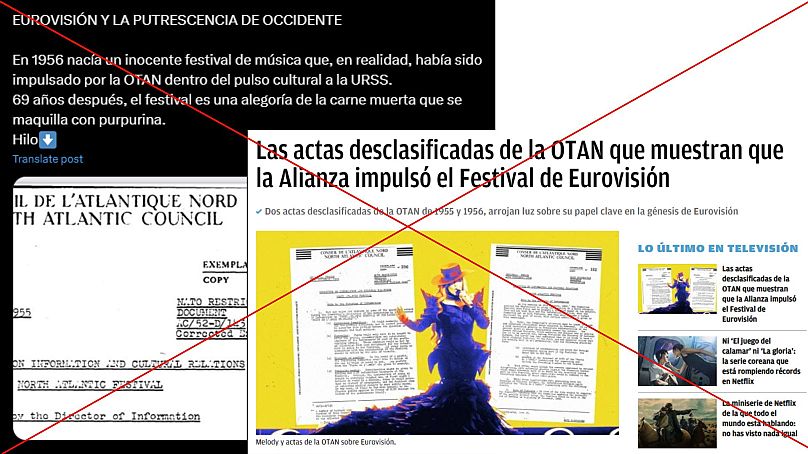
Social media posts and certain news sources claim that the military alliance aimed to utilize it as a tool for extending its soft power through imperial means throughout the Cold War era and afterwards.
Several shared posts included images of a document from NATO’s Committee on Information and Cultural Relations, dating back to November 1955. This document mentions a “North Atlantic Festival.”
The paper suggests that a "performance" might serve as an understated method to promote a pro-NATO storyline within the broader public.
The document suggests potentially distributing NATO informational pamphlets during the festival," it reads. "Nonetheless, the wisdom of this action needs thorough consideration, as initially, I think it would be unwise because it could bring in propagandistic elements, whereas the festival seeks such outcomes through subtler methods.
"Regardless, it would be much more natural to shape public sentiment towards NATO via the performance itself," it goes on to say.
The North Atlantic Festival is not the same event as theESC
However, while the document is authentic , it's been taken out of context. It and other NATO archives show us that the alliance did float the idea of a "North Atlantic Festival", but it was nothing like the Eurovision Song Contest and never even came to be as originally conceived.
It was to take place on the sidelines of a popular, annual military exhibition by the French army known as "Les Nuits de l'Armée", sponsored by French magazine Paris Match. The display featured various performances and attracted thousands of spectators in Paris every year.
NATO stated that 'NUITS DE L'ARMEE' are beloved not just due to the exceptionally high quality of the performance and the superb physical setup, but also because audiences adore the glamour and spectacle of such an serene military demonstration. one of the documents .
This final aspect has prompted the publishers of 'Paris Match' to consider organizing a North Atlantic Festival similar to France’s 'Nuits de l’Armée,' where chosen units from the different NATO countries' military forces will participate.
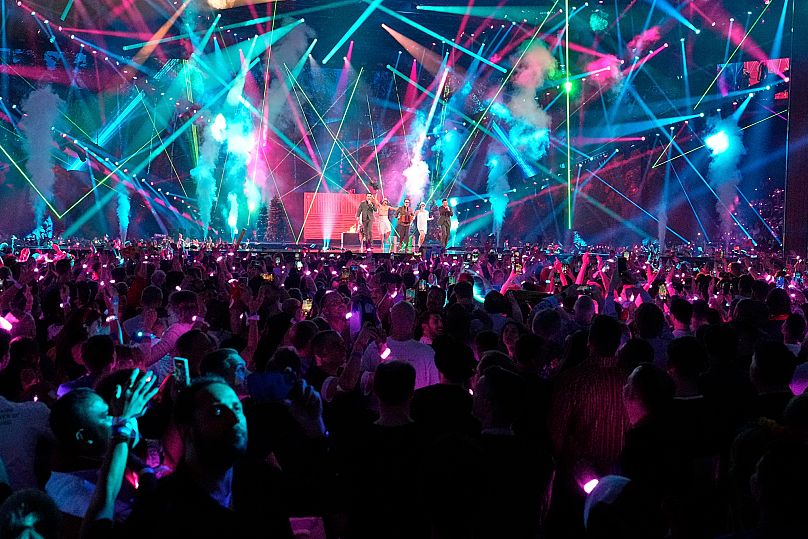
The concept was to present various cultural military demonstrations from distinct NATO countries, featuring a traditional Scottish parade with bagpipes originating from the UK, a show by Belgian canine officers, along with a change of guard ceremony performed by Canadian Royal Northwest Mounted Police.
Online assertions seem to partly stem from the year when the Eurovision Song Contest commenced: 1956, which follows shortly after NATO released several of these documents. It’s possible that the “North Atlantic Festival” has been confused with the Eurovision Song Contest due to similarities in their goals and intentions—both aim to foster unity and harmony within Europe and highlight cultural and media exchanges throughout the region.
Another document mentions that the BBC proposed airing the festival across Europe via the Eurovision network, which is operated by the European Broadcasting Union (EBU).
"The North Atlantic Festival project having recently been mentioned in London when the Information Division contacted the BBC Television Service, the latter stated that it would certainly be prepared to see that the programme was retransmitted over the Eurovision network (United Kingdom, France, Germany, Italy and the Netherlands)," NATO says in the document.
"The BBC officials mentioned that an event like the North Atlantic Festival was precisely what they were looking for," it states.
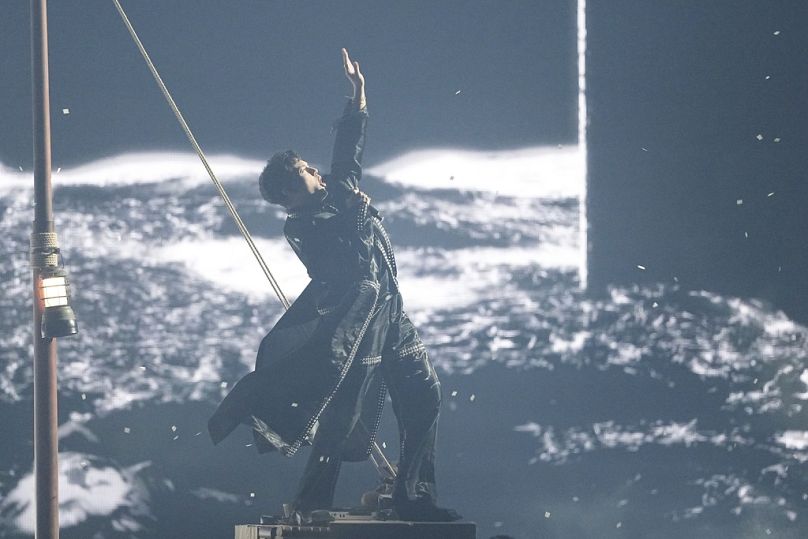
Despite this, the Eurovision network is not identical to the Eurovision Song Contest: the former refers to a television and radio content exchange system established by the EBU in 1954 throughout Europe, whereas the latter is an individual entertainment event that leverages this network to televise a live musical contest involving various nations.
The Eurovision Song Contest's website states that the idea for the network came from Marcel Bezençon, director general of the Swiss Broadcasting Corporation, and that the idea for the contest came from RAI, Italy's national broadcaster.
As stated on their website, 'The most prominent and victorious program produced by the Eurovision Network has been its flagship event: the Eurovision Song Contest.' Following recommendations made during the Programming Committee’s gathering in Monte Carlo, Monaco in 1955, the European Broadcasting Union opted to launch this contest after approving it at the subsequent assembly held in Rome later that same year.
"The idea behind the Contest originated with RAI, having organized the Festival di Sanremo (Sanremo Italian Song Festival) since 1951 in the coastal town bearing the same name," the passage goes on to say.
It’s incorrect to claim that the Eurovision Song Contest was established to promote pro-NATO propaganda against the USSR and subsequently Russia, as certain social media posts assert. Until their suspensions in 2022 and 2021, respectively, both Russia and Belarus were active members of the European Broadcasting Union and took part in the Eurovision Song Contest.
Both nations are not part of NATO, which also demonstrates the military alliance's independence from the EBU.
Ultimately, a NATO official told EuroVerify that the alliance played no role in the creation of the song contest, describing claims to the contrary as inaccurate.
A representative for the Eurovision Song Contest, however, stated that "these allegations hold absolutely no truth whatsoever."
"The Eurovision Song Contest was established by the European Broadcasting Union in 1956, and they still manage the event for their members — these are 56 public service broadcasters from different countries," explained the spokesperson.


Post a Comment for "Fact Check: Was NATO Behind the Creation of Eurovision?"