Alex Horne: "As a White Man in My Late Forties, I Know Some Things Just Can't Be Said"
When he was young, Alex Horne And his buddies really enjoyed excavating holes. Quite large ones too—likely around five or six square feet each—dug into the ground in the forest close to his folks' home.
“ You dig and dig and dig,” he says. “And then you find corrugated iron that will cover it. And then you cover that with earth and sticks and leaves so no one can see your hideout, and then you sit in it and light candles.” He and his gang of friends would get in there and have a chat. “I don’t know what we talked about. Well, we’d mainly talk about where we should build the next hole.”
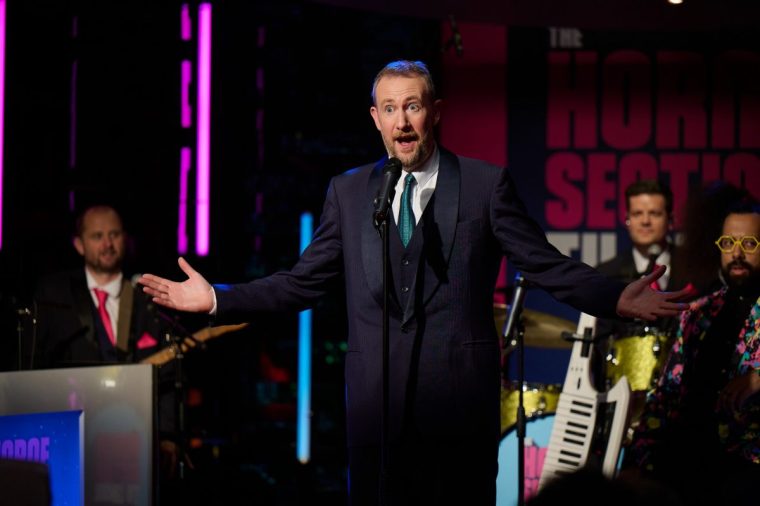
On a sunny Tuesday noon in late March, the rear section of a pub in Mornington Crescent, adorned with football scarves, remains tranquil. We convene as a particularly Horne-dominated summer begins. He is known as Little Alex Horne in the upcoming episodes of the series. Taskmaster , the immensely successful global hit game show that has begun transforming television since its launch; he’s now getting a new sitcom series The Horne Section television series Alongside his comedy group members making public appearances; he has also authored a children’s book.
Read Next: Taskmaster's Alex Horne says, "I would avoid making a joke about the Queen passing away."
The Horne Section are a cult thing – “ so culty; as in, I’m not even sure you can give it that grand a term” – and the second series of their slightly manic, extremely daft show leans into it. Ostensibly about Horne’s efforts to get the group on the TV, it chucks in The Horne Section’s trademark comedy songs, appearances from members of the extended Horne universe like US Taskmaster host Reggie Watts and old friend John Oliver and some extremely, extremely amusing circumstances.
There isn't actually anything distinctive about us," Horne chuckles weakly before continuing, "but that's simply because we're huge admirers of Vic and Bob as well as 'Father Ted' and 'Monty Python.' That's just our taste. To tell the truth, we recognize quite clearly that we are six middle-aged Caucasian males in our late forties. Since we have nothing substantial to contribute, there seems little reason for us to attempt saying much.
He adores Sophie Willan’s sitcom. Alma’s Not Normal , which transforms her traumatic childhood into something inspiring. "She needs to create that kind of show, and I need to produce this type of content, because if I attempted to make her kind of show, what’s my purpose?" he explains. "Therefore, I must fully commit to the opposite approach—just focusing on being silly."
Which sounds a lot like a man shruggingly accepting his silly lot in life, but over the past 20 years, Horne has made himself the go-to silly man on British TV. In July it’ll be 10 years since Taskmaster first went out on Dave , and we speak just before its 19th series is released.

It would have required quite an effort to avoid bumping into someone. Taskmaster By this point, each series features five humorous individuals competing for points awarded by the Taskmaster. Greg Davies In a sequence of perplexing and absurd challenges, some tasks appear straightforward while others are complex. Each one has significant potential for things to go awry and encourages creative problem-solving methods. Consider Sally Phillips directing a mini-play where she flirts with a water dispenser, James Acoster figuring out the perimeter of a camper van using baked beans, or Jenny Eclair attempting to spear rubber bands with a pole while standing on a raft.
Taskmaster had a somewhat homemade, charmingly creaky feel when it initially launched on Dave, and gained widespread popularity after moving to Channel 4 in 2020 — the same year it claimed a Bafta award. Today, it serves as a major stage for previously lesser-known comedians and has become a merchandise powerhouse.
Taskmaster was initially an Edinburgh production from 2010 born out of – as Horne puts it – sincere envy towards his former roommate. Tim Key Had clinched the Perrier award when Horne didn't perform for a year. "It's certainly bizarre that it's still running," remarks Horne. "Yet since it happened gradually over time, it has simply turned into my lifestyle."
Taskmaster didn't start off as popular. Among the initial pair of reviews for the premiere episode that Horne came across, one was highly complimentary, whereas the other was quite scathing. That night, he found himself unable to rest due to these contrasting reactions. Currently, it is produced in twelve different nations, accompanied by spin-off literature and merchandise – notably, the Christmas crackers stand out – along with a live show at Canada Water in southeast London. Additionally, it has sparked an entire surge of similar productions. Taskmaster -ish TV: lighthearted, competition-driven content with "not as much of a cutthroat environment for getting your humor across".
"I don't mind watching a performance where you reflect, 'I believe we may have had an influence.' I consider that to be a compliment and fantastic," he states. "However, Taskmaster Didn’t receive commissions for a long time because it wasn’t quite like anything out there. Sure, it shares similarities with certain shows, yet it defied several television norms. Kudos to Dave for greenlighting something distinct. However, I feel somewhat exasperated when others aim to replicate its success instead of asking, “What’s new now?””
Read Next: I tried the Taskmaster live experience – it didn’t go to plan
It perhaps says something that Horne chucked in solo stand-up shows completely once Taskmaster – and in that very year, The Horne Section - joined forces. He feels most content when he gathers a group of humorous individuals instead of working solo. What is the reason for this preference?
“I am … I believe I might be somewhat — perhaps I'm not though.” A brief silence follows. “I feel a little uncertain about my capabilities, so I've relied on supports and aids. The initial time I stepped onto a comedy stage, I carried a bag that remained unopened throughout.” It seemed both artistic and mysterious to him. “The truth is, I held onto it because it gave me something tangible to grasp, and also because it meant people would focus less on me alone,” he explained.
He enjoys performing alongside his buddies as well. He attended Lancing College, an independent boarding school in East Sussex, where he thrived thanks to his athletic abilities and popularity. Nonetheless, he maintained strong ties with his local pals—such as Ben Reynolds and Joe Auckland from the Horne Section—and would return home every weekend to spend time with them.
“We excavated numerous pits, set up several camps—pretty standard activities.” He gives a casual shrug. "I started drinking around 15 years old, just like most young folks. While I didn’t cause significant problems, I did find myself in some minor predicaments." His parents viewed these pit-digging endeavors mostly with amusement rather than concern. He acknowledges that he has generally led an uneventful life, mentioning only one major event: losing his pet at age 21. “There isn’t much deep emotional turmoil to explore," he adds somewhat apologetically, "but I truly relished acting foolish during my childhood.”
Thus began his involvement with digging holes. His penchant for humor found expression during his studies of classical subjects at Cambridge University, where he became part of the Footlights club while notable figures like Richard Ayoade, John Oliver, David Mitchell, and Robert Webb were also members. Horne contributed by writing pantomimes, including one Treasure Island where Long John Silver performed rap music in an Eminem style.
“He thought they looked nice…” He hesitates. “But they didn’t have much money. Despite this, we had great times together, and it was my initial venture into teamwork; I thoroughly enjoyed it." This period introduced him to Tim Key, who claimed he was pursuing a PhD just so he could join Footlights secretly. Together, they moved to West London where they lived alongside each other. Alongside Horne, Key, and another comedian-friend named Mark Watson often performed at the Canal Café Theatre in Paddington before returning to Edgware Road for some chicken shawarma. What was Key like as a roommate? "Not very tidy. We both neglected cleaning our towels which made them rather stiff. However, living with him remained an enjoyable adventure nonetheless."
As we part ways, he reveals a tattoo on his arm depicting a pineapple sporting sunglasses. This whimsical desire, this compulsion to delve into the dirt and sculpt a small universe, won't vanish anytime soon.
“I just hope I’m not coming across as too at ease discussing my serious side,” he remarks. “It’s really awkward. Just wanted to get that noted.” hate it.”
He instantly springs back the opposite direction. "I don't dislike it. However, it is so mortifying, taking yourself seriously.”
Taskmaster and The Horne Section TV Show are available to watch on Channel 4 Alex Horne’s children’s book, The Last Pebble is set for release on July 3


Post a Comment for "Alex Horne: "As a White Man in My Late Forties, I Know Some Things Just Can't Be Said""