Why Proposals on One Knee? The Surprising Origin Will Leave You Speechless
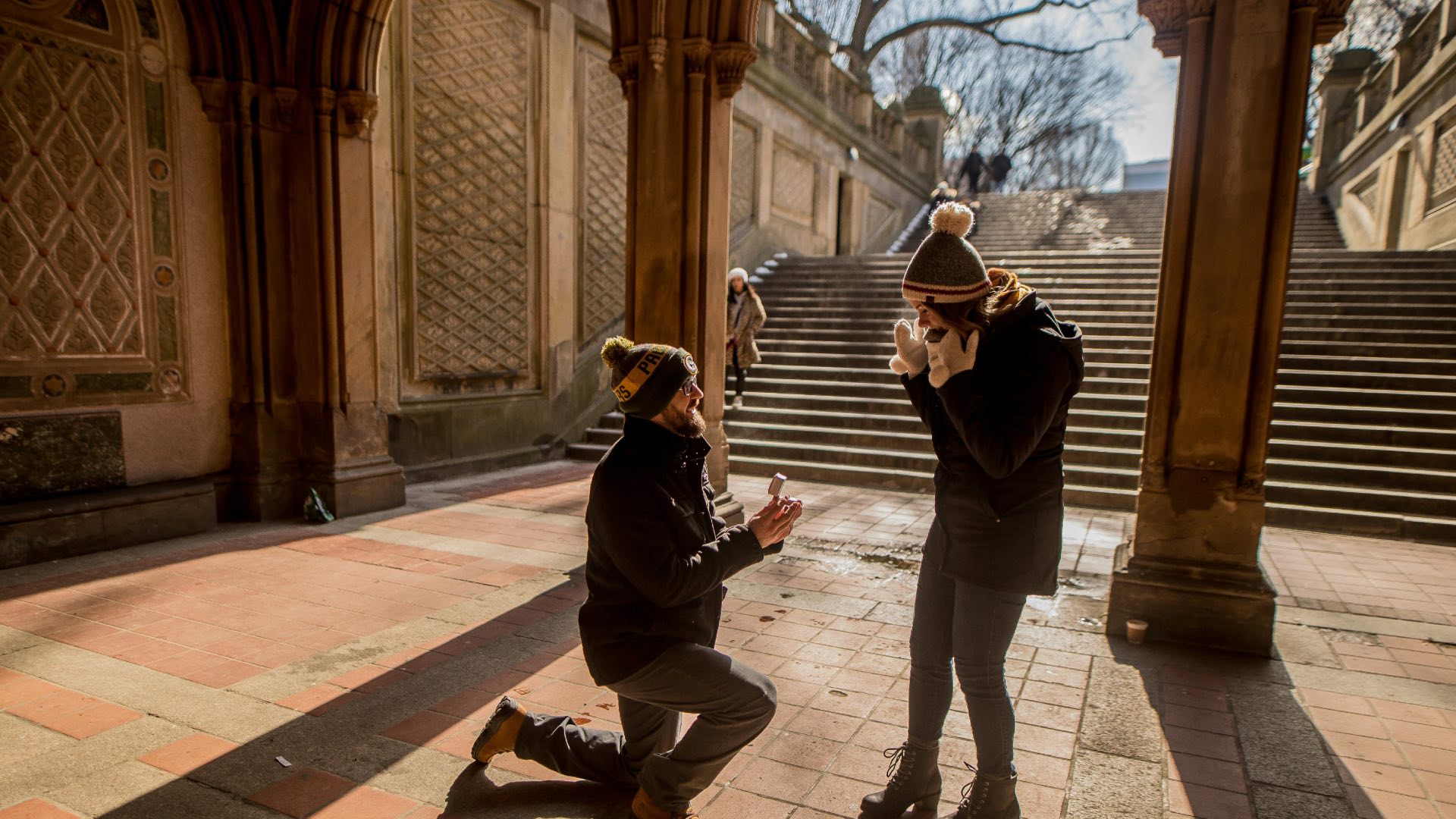
With one knee resting on the ground, a ring presented within an open box, gazing upward at the other person: this widely recognized scene captures the significant instant of proposing marriage. However, what precisely is the reason behind dropping to one knee when asking for someone’s hand in marriage?
A gesture passed down from medieval times
This action goes beyond being simple. It carries deep historical significance, rich symbols, and even paradoxes. Although it is currently seen as a gesture of romance, its origins are much more intricate and surprising than most would think.
The origin of the kneeling gesture is believed to trace back to medieval times, where it had nothing to do with romance. During this era, kneeling symbolised acts of loyalty, humbleness, and dedication. When knights pledged fealty to their lords, they knelt as a show of commitment. This posture was also employed in front of religious figures, monarchs, or queens during ceremonies involving servitude or faithfulness.
Thus, asking for someone's hand by kneeling on the ground could be interpreted as a transfer of these ancient codes of submission, a strong symbol of respect and commitment, coming from the warrior and religious sphere.
Religious and sacred symbolism
Within Christian practices, the action of kneeling is closely associated with prayers and communicating directly with God. It embodies an attitude of meekness towards the divine. This aspect notably shaped romantic ceremonies, particularly during eras where matrimony was primarily viewed as a holy covenant, sanctified by religious institutions.
Bowing down, the devotee assumes a nearly spiritual stance, seeking not heavenly absolution, but a "yes" laden with promise and dedication.
A loving act inspired by drama and artistry
Even though the origin of this gesture dates back to the medieval era, Its widespread use within a romantic context truly emerged during contemporary times. , notably thanks to literature, painting and theater. Chivalrous love scenes, where the man declares his flame with devotion, have been multiplying since the Renaissance. In paintings as in plays, heroes in love kneel, not only to show their respect, but also to illustrate the dramatic tension of the moment.
This stance transforms into an aesthetic code, subsequently embraced in movies, literature, and later integrated into modern popular culture.
Hollywood and the export of a universalized ritual
It wasn't until the 20th century, particularly with the advent of Hollywood cinema, that getting down on one knee became an almost obligatory part of a marriage proposal. Romantic comedies, starting in the 1950s, developed a narrative model where the proposal was made with a ring, a knee on the ground, and an emotional response. This model was exported worldwide, establishing itself as "the" way to make an official proposal.
Paradoxically, this action, which is now seen as customary, is actually a product of contemporary presentation. The entertainment sector has spread, systematized, and idealized it over time.
A stance that faced criticism and was later reinterpreted
Today, this practice has faced critique. Certain feminist and LGBTQ+ perspectives challenge the implication of submissiveness inherent in such an act, especially since it typically involves men alone. In a romantic scenario, kneeling might reinforce traditional gender roles, with the man being submissive and the woman taking charge.
As such, an increasing number of couples are opting to modify or redefine this significant moment: they might propose mutually, stand during the engagement, use alternate symbols (like a wristwatch, a shared piece of jewelry, a tattoo, etc.), or even forego a traditional ceremony altogether. While the iconic scene of one partner going down on one knee still holds considerable emotional weight, it is no longer considered an absolute requirement.
A hint from yesterday lingers in today’s affection
Even with all these difficulties, the proposition presented humbly persists in capturing imaginations. This might be due to how it encapsulates an instance of presumed frailty—the precise moment when we unveil our true selves and acknowledge our lack of mastery over every aspect of life. Additionally, it brings forth a particular kind of 'traditional' romance, a nostalgic love story that comforts us and fuels our aspirations.
Actually, if this gesture has endured over the years, it is because it conveys, without words, a crucial message: I am committed, and I acknowledge you as a significant person deserving of this serious occasion.
Kneeling down on one knee to ask for someone’s hand in marriage isn’t just symbolic. This tradition stems from medieval chivalric norms, later blessed by religious practices and enhanced through various art forms, evolving into a ceremony all its own. The intensity of emotion behind this act comes partly from how dramatic it is and also due to its historical roots. Despite being reinterpreted or dismissed by some modern individuals, it still captures that poignant instant where affection turns into commitment.


Post a Comment for "Why Proposals on One Knee? The Surprising Origin Will Leave You Speechless"